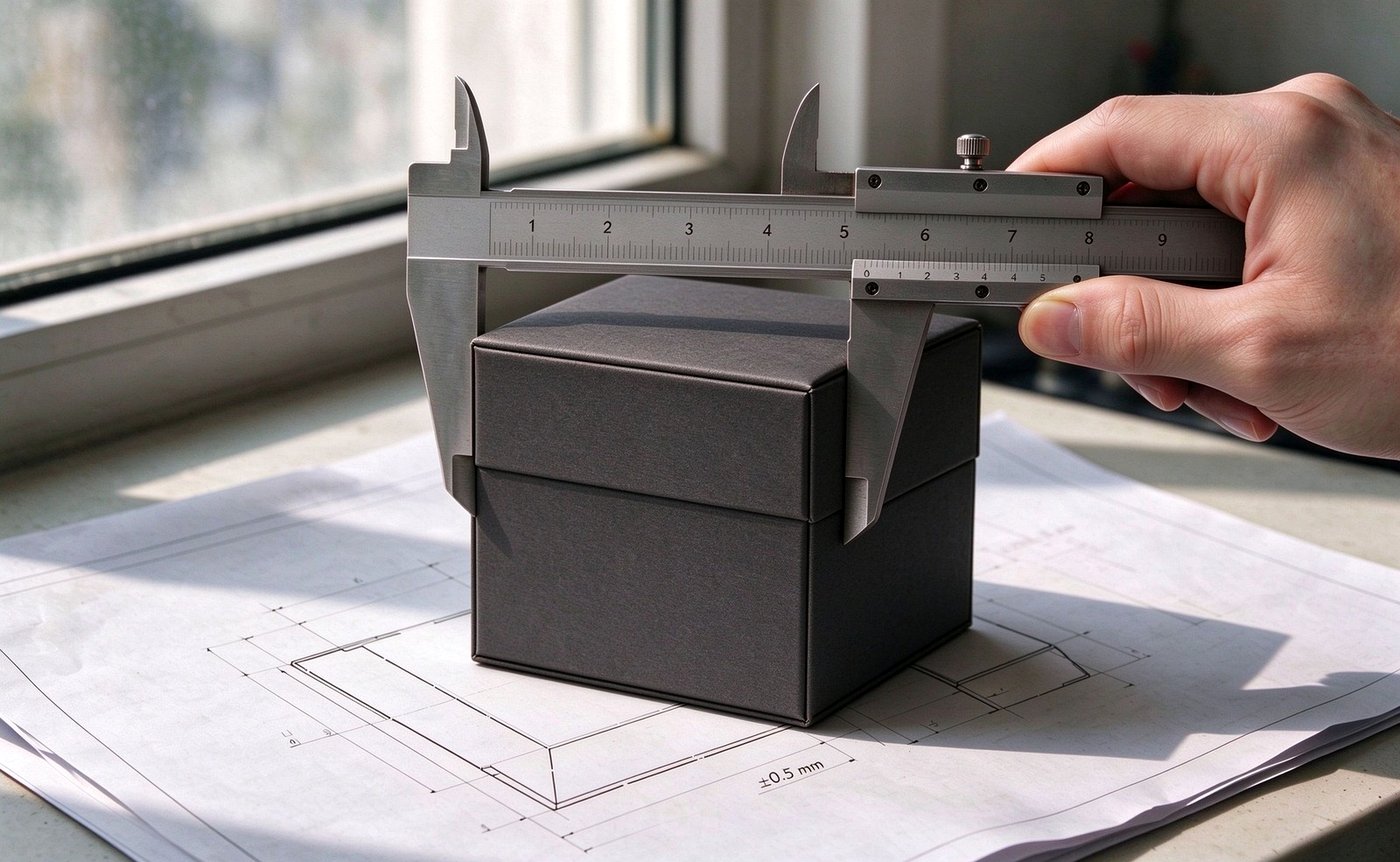
Supplement cartons are not generic cartons
A box that holds a 120-count bottle has to clear five separate constraints before it ever reaches a shelf. Most of the failures we are asked to fix come from a supplier who only checked one of them.
Five constraints, in the order they bite
We check these at quotation stage, not at proof stage. Catching them late is what turns a 12-day run into a 30-day one.
Bottle fit
Bottle OD, cap height and any desiccant canister all eat into the internal dimension. A 120 cc HDPE bottle is typically 48–52 mm OD with a 22–24 mm cap — the carton needs roughly 4 mm clearance per side, or it will bulge at the crease.
Regulatory panel
The Supplement Facts panel is not a design choice. 21 CFR 101.36 fixes its content and relative type sizes, and it usually consumes 45–60% of one panel. We plan the layout around it before artwork starts.
Odour and taint
Capsules absorb smell. Standard offset inks and solvent adhesives will migrate into the product over a 24-month shelf life. We specify low-migration, low-odour inks and test organoleptically on request.
Moisture
Hygroscopic actives need a barrier. Options are a PE-coated board, a desiccant canister with a reserved cavity, or a sealed inner liner. Each changes the internal dimension, so it has to be decided before tooling.
Transit durability
Retail distribution and e-commerce are different tests. Amazon ISTA-6 is the one that catches most suppliers out — it needs a heavier board or a corrugated outer, not just a nicer finish.
What this means for your quote
Send us the bottle spec and the market, and we can quote a carton that passes all five on the first sample. Without them we are guessing, and guessing costs you a re-run.
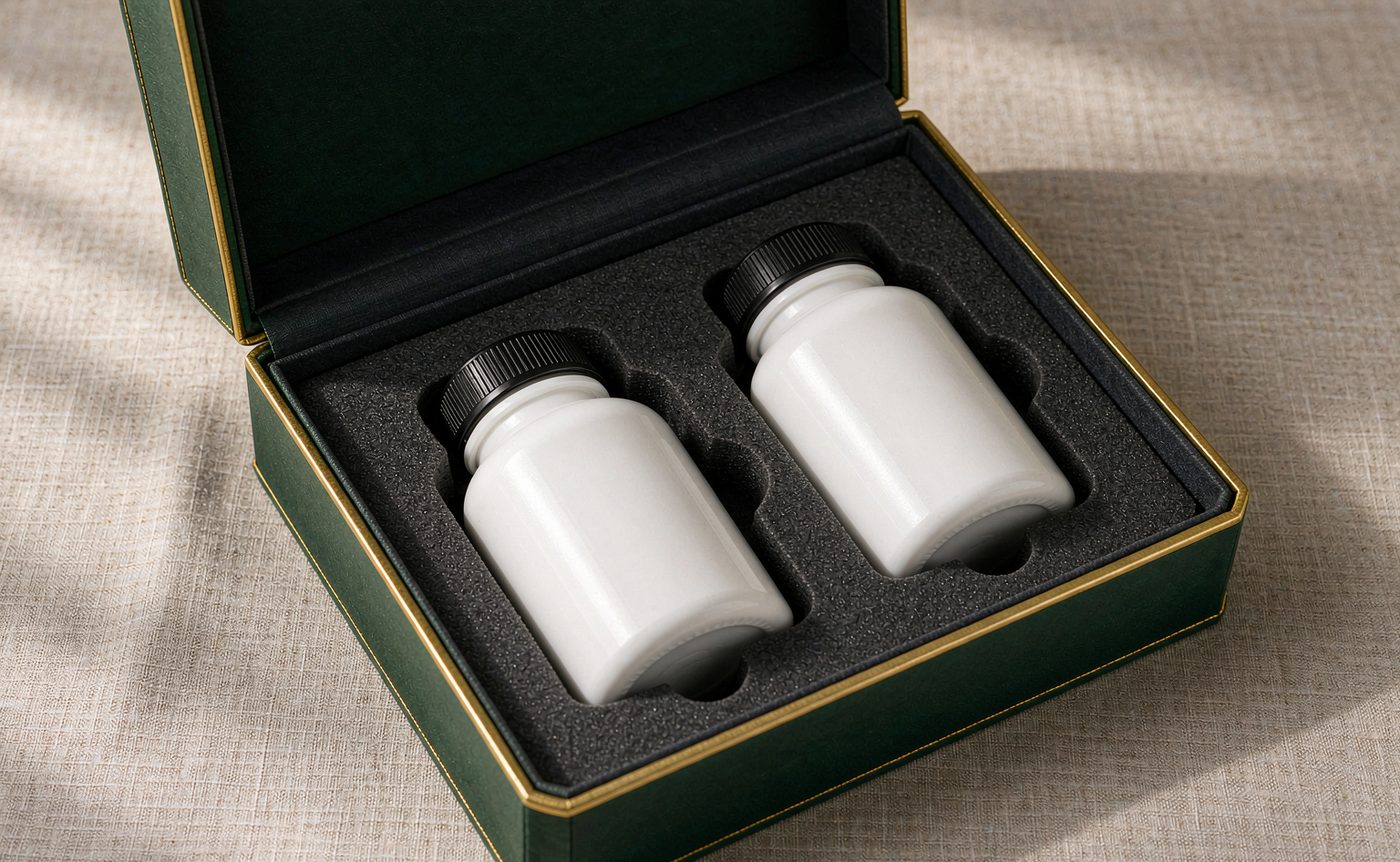
Three of those five end up in the insert: bottle fit, the reserved desiccant cavity, and what happens on the drop test. The eight tray formats we cut — flocked, foam, EPE, blister, paperboard and two silk builds — are on the inserts section of the box page.
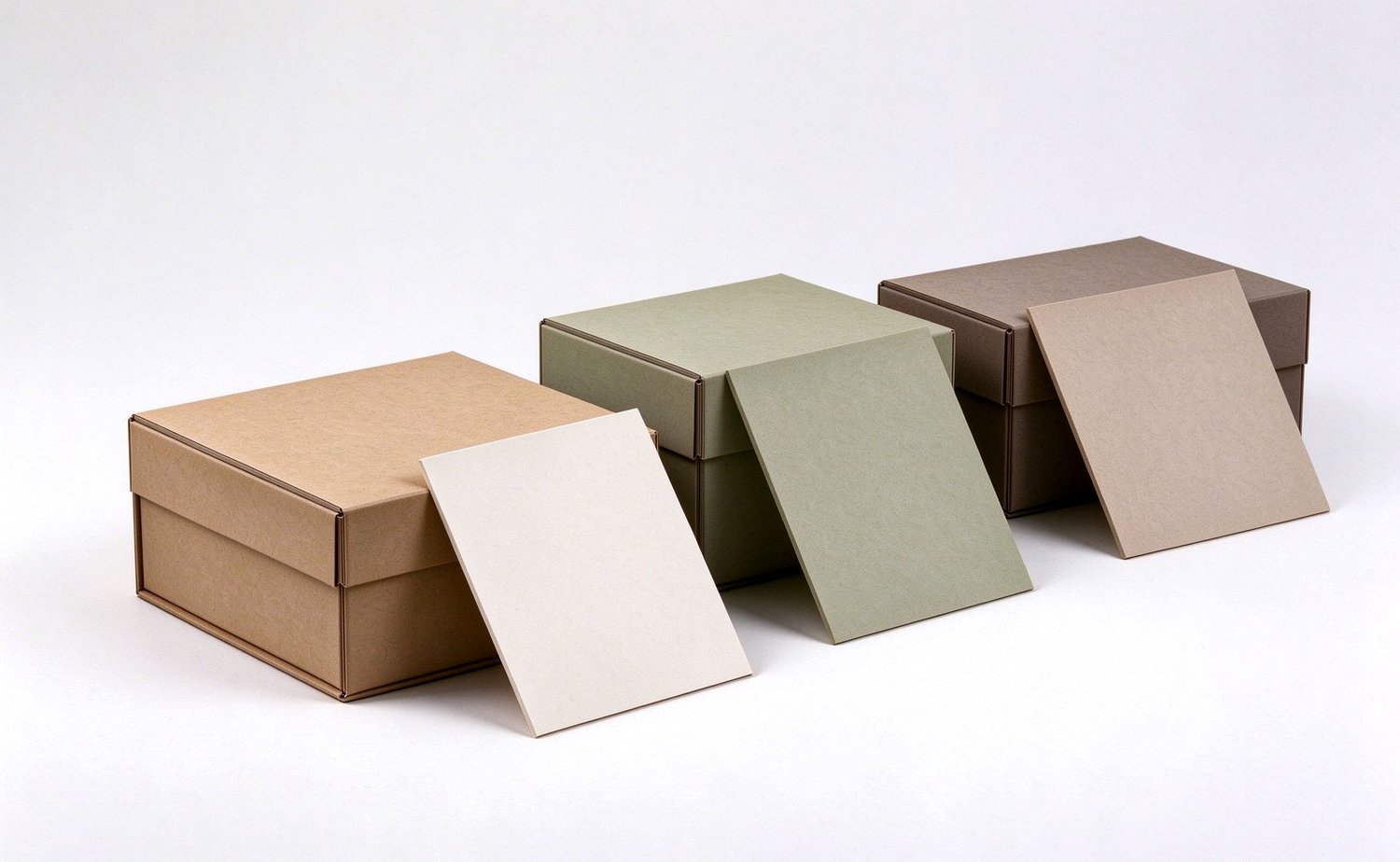
Common configurations
Internal dimensions for the formats we run most often. All figures are carton ID in millimetres, assuming 4 mm clearance around the bottle.
| Format | Carton ID (L × W × H) | Board |
|---|---|---|
| 60 cc round bottle, 60 ct | 58 × 58 × 105 | 300 gsm |
| 120 cc round bottle, 90–120 ct | 62 × 62 × 130 | 350 gsm |
| 150 cc round bottle, 120–180 ct | 68 × 68 × 145 | 350 gsm |
| 250 cc square bottle | 72 × 72 × 160 | 350 gsm |
| Powder pouch in carton | 120 × 40 × 190 | 350 gsm |
| Stick pack, 30 sachets | 105 × 35 × 145 | 300 gsm |
| Blister carton, 2 × 15 | 95 × 28 × 130 | 300 gsm |
These are starting points, not limits. Use the configurator to set an exact size and download the dieline.
Three recent runs
Client names withheld under NDA. Dimensions and quantities are real.
| Client type | Brief | What we did | Result |
|---|---|---|---|
| US contract manufacturer | 120 ct cartons, 5 SKUs, monthly replenishment | STE, 350 gsm, 4C + spot UV, crash-lock for their auto line | 25,000/month, 14-day cycle, 3-year running account |
| DTC supplement brand | First launch, 60 ct, needed premium feel on a startup budget | RTE, 350 gsm, matte lamination + gold foil logo, digital print | 8,000 first run, reordered at 20,000 within 5 months |
| EU wellness brand | Kraft look, FSC required, EU market | STE, 300 gsm FSC kraft, 1C black + blind emboss | 12,000/quarter, FSC chain-of-custody documentation supplied |
What we need to quote accurately
Five items. With all five we return a firm price in 24 hours; without them we return a range and a list of assumptions.
- Bottle or container spec — OD, height, cap type
- Fill count and target carton ID, if already set
- Artwork status — print-ready, or still in design
- Destination market, so we apply the right compliance set
- Annual volume and first-order quantity